
Operation Wilderness brings together immersive wilderness experiences and licensed clinical partners to help those who serve and have served heal from PTSD and service-related trauma, and rediscover resilience, community, and purpose.
We envision a future where healing from service-related trauma isn't confined to a clinical setting — where the wilderness stands alongside licensed care as a trusted path for those who serve and have served to find their way back to purpose, resilience, and each other.
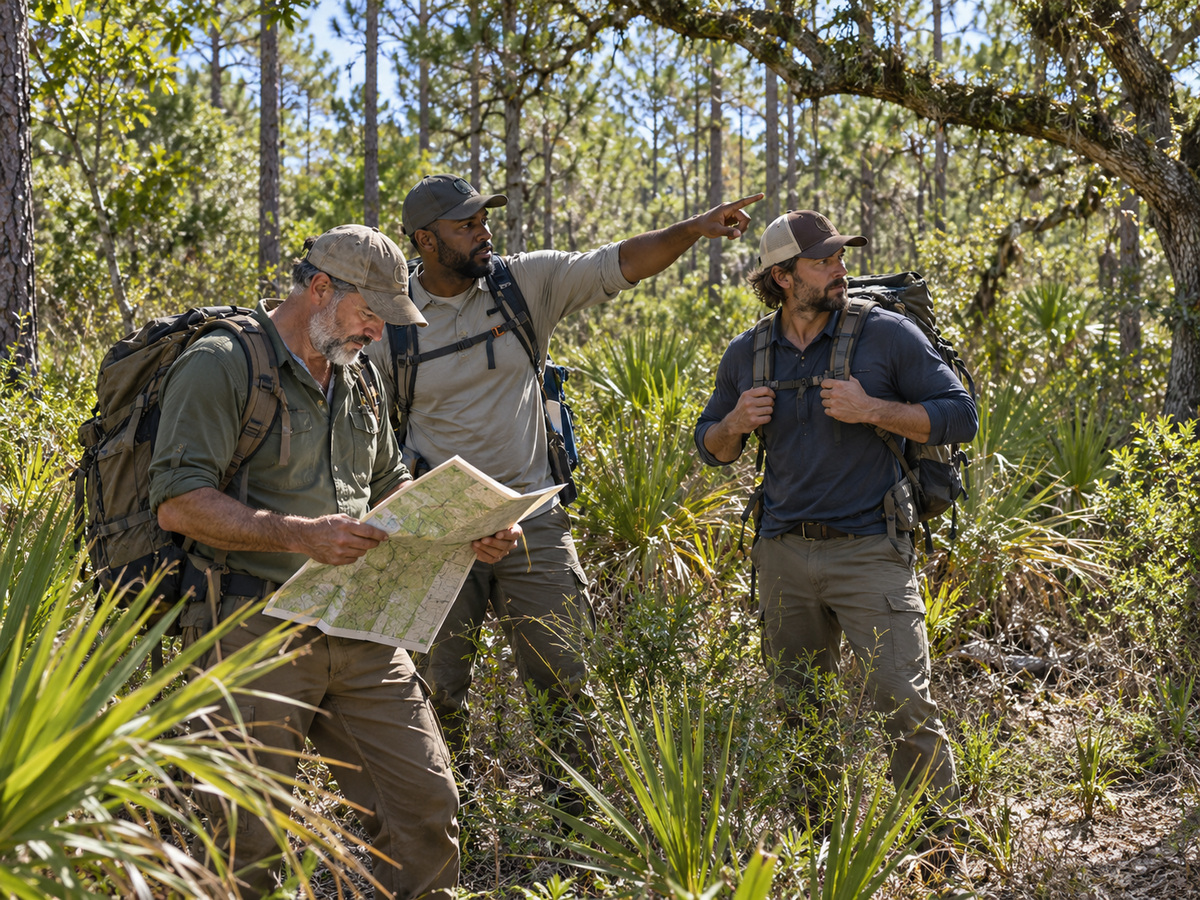
Op Wild is a veteran-owned and operated nonprofit. We were founded by people who've lived inside this problem — combat veterans, family members of veterans, and lifelong outdoorsmen who know what the wilderness can do for a person when everything else has fallen short.
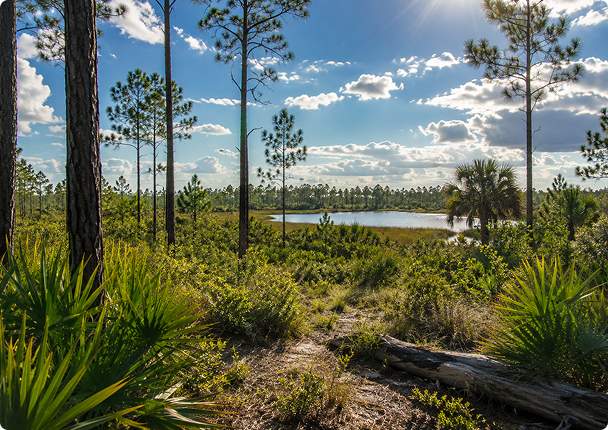
We operate in Florida's wilderness — raw, unspoiled, and far removed from the noise of everyday life. It's not a resort. It's not a conference room with trees outside. It's the kind of place that demands your presence and gives something back in return.
Op Wild delivers the wilderness experience. Clinical and mental health support is provided exclusively by our licensed clinical partners — learn more about them here.
Op Wild didn't start in a boardroom. It started with people who understood the problem firsthand and decided to do something about it.

Our board brings military service, financial accountability, and community leadership to the table. Several also had a hand in building Operation Wilderness from the ground up.
Op Wild is not a clinical provider. We don't diagnose, treat, or manage the mental health care of our participants — and we don't claim to. We deliver the wilderness experience. Our licensed clinical partners deliver the clinical care — pre-program screening and clearance, licensed counselor support in the field alongside our program staff, emergency clinical and medical response, post-program follow-up, and all HIPAA-compliant participant records, which they own and maintain exclusively.

Research has consistently shown that exposure to natural environments produces measurable physiological and psychological changes — reduced stress markers, improved cognitive function, and greater emotional regulation among them. This isn't a new idea. It's a well-documented body of work spanning decades and disciplines.
For veterans specifically, studies examining nature-based programs have produced findings that are difficult to ignore. The research is what brought us here. We're not the first to see it — but we intend to be part of making it more accessible.
The science behind nature-based therapy draws from the four independent fields of research — each arriving at similar conclusions from the different directions.
Research suggests natural environments can trigger a physiological relaxation response — including reductions in cortisol, heart rate, and blood pressure. Ulrich's work has been replicated across a wide range of populations and settings.
The Kaplans' research proposes that natural environments support cognitive recovery by engaging what they call "soft fascination" — an effortless form of attention that allows directed mental effort to rest and restore.
Wilson's hypothesis holds that humans have an innate tendency to seek connection with other living systems. Research building on this framework explores how natural environments may support psychological well-being and reduce feelings of isolation.
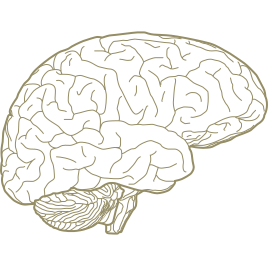
A growing body of neurobiological research examines how nature exposure may affect brain activity and structure — including regions associated with stress response and emotional regulation. This area of study is active and ongoing.
These findings come from independent studies on veteran populations and nature-based programs — not from Op Wild. We share them because they're part of the foundation this organization is built on.
of veterans from recent conflicts experience PTSD in a given year, according to the U.S. Department of Veterans Affairs
VA National Center for PTSDin sleep quality, perceptual stress, and PTSD symptoms observed in veterans following outdoor recreation program participation
Military Medicine, Vol. 178, 2013 — PubMedOutdoor recreation program participation predicts improved psychosocial well-being among veterans with PTSD — including significant improvements in sleep quality, stress, and PTSD symptoms at 6-week follow-up.
Vella, Milligan & Bennett, Military Medicine, 2013Veterans participating in a 10-week nature-based therapy program reported improvements in PTSD symptoms and developed tools to handle stressful situations more effectively.
Poulsen, Stigsdotter, Djernis & Sidenius, Health Psychology Open, 2016Exposure to nature is linked to improved attention, lower stress, better mood, and reduced risk of psychiatric disorders — with research supporting stress reduction theory, attention restoration theory, and the biophilia hypothesis.
APA Monitor on Psychology, April 2020Up to 29% of veterans who served in Operations Iraqi Freedom and Operation Enduring Freedom experience PTSD in a given year.
National Center for PTSD: How common is PTSD in VeteransEvery act of charity directly affects our ability to deliver profound services to those who selflessly serve and have served our country. Become a member of the Op Wild Mission Support Team.